North Brother Island
The ChangelingNorth Brother Island is an abandoned island in the East River whose institutional history is repurposed when the Wise Ones and their children return to live there. Its ruined hospital buildings and reclaimed grounds first appear as a hidden settlement beside New York City; later, as violence forces the community to evacuate, the island’s old paths and ferry landing become part of their escape. For Apollo Kagwa, reaching it is more than arriving at a secluded place: Cal describes the crossing as entry into a world where the rules are different.
Institutional History and Abandonment
The island remained uninhabited until 1885, when Riverside Hospital was established to treat people with smallpox. The hospital later treated other quarantinable diseases, and its grounds grew into a substantial complex. The facilities included a treatment center, library, staff dormitories, chapel, foundry, stockhouse, coal storage house, Doctor’s Cottage, recreation center, and morgue, as well as roads and sidewalks. The island’s built environment had once supported a working institution with its own internal routes and services.
After World War II, the island housed war veterans. In the 1950s, it became a treatment center for drug addicts, but the center eventually closed amid corruption among its staff. By 1981, the smallpox patients were long gone, the veterans had been evacuated, and the drug treatment program had ended. The island’s institutional uses had successively changed, then ceased, leaving its buildings to deteriorate.
For more than twenty years, North Brother Island became known as a nesting colony for the Black-crowned night heron. The birds eventually abandoned it in the early twenty-first century, for reasons that remained unknown. Their departure had attracted little attention beyond birdwatching interest. Apollo’s arrival supplies a startling explanation: the island has been occupied again, this time by women and children. The return of human settlement displaces the birds, reversing the island’s apparent transition from public institution to wildlife refuge.
The Wise Ones’ Settlement
The Wise Ones do not settle in the island’s largest or strongest surviving building, the Tuberculosis Pavilion. They make their base in the Nurses’ Residence, a four-story, U-shaped Gothic Revival building completed in 1904 to house 125 nurses. Its windows have been destroyed by natural forces, but the residents have begun repairing them with clear plastic. Firelight glimmers against those makeshift panes. A fire on the second floor of the nearby Doctor’s Cottage, whose facade has fallen away, first looks to Apollo like an isolated flame; from the settlement, it functions more like a signal, a fixed point guiding people back to their base.
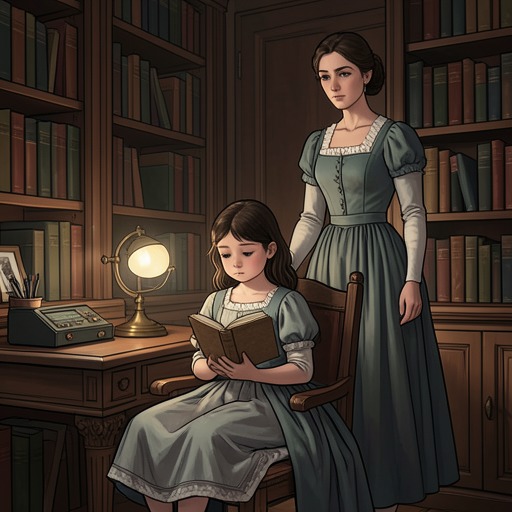
The buildings and spaces have distinct parts in the life Apollo witnesses. Women move between the Nurses’ Residence and Doctor’s Cottage, while children peer out through the plastic-covered windows. The School, another building overlooking the courtyard, has a room lit by electricity. The community has restored it to use as a one-room schoolhouse: children file inside, sit before a blackboard, and later return to the courtyard for recess. Older children play tag; others throw or kick plastic balls. A little girl tries to ride a scooter across the uneven brick, falling and getting back up, resisting an adult’s attempt to help her.
That scene makes the settlement legible not simply as a place of refuge but as a community organizing daily life around its children. Apollo hears the racket of play and is overwhelmed by the ordinary presence of children there. The contrast is sharp: a decaying medical complex that once contained people separated from the wider city now holds a school, a courtyard, and a population living together. Cal tells Apollo that the island had been North Brother Island, but that the Wise Ones arrived and remade it.
Apollo’s Arrival and the Island as Threshold
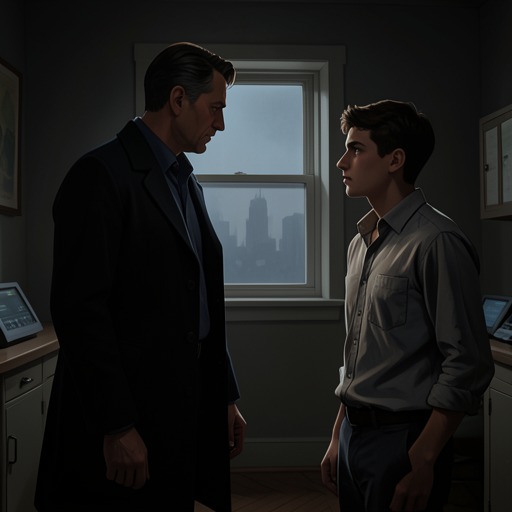
Apollo reaches the island by boat with William Wheeler. The journey takes them through the East River, but Cal later distinguishes the final approach from the waters Apollo has known: as they near the Wise Ones’ island and beach the boat, they cross into a different shore, a place where the world’s rules differ. Her explanation recasts the arrival as a boundary crossing rather than a simple landing. The island is close to New York City—Apollo’s apartment is less than four miles away—yet the settlement initially seems to him like a village concealed in an earlier, unfamiliar world.
When Apollo first sees the residents, he walks out of the shadows into the courtyard without asking William what to do. His apparent boldness does not mean he is unafraid: his breathing is constricted, and he repeats to himself the mantra that he is a god. The Wise Ones attack and beat him. Afterwards, four women improvise a stretcher from chair legs, carry him away, and leave his arms, head, and legs hanging beyond its narrow support. The episode reveals a community prepared to defend itself, as well as its coordination: the four-woman team carries him away in a minute and fifty seconds. Children watch from the Nurses’ Residence, women watch from the Doctor’s Cottage, and a figure at the School window observes him longer than anyone else.
Apollo’s understanding of the place develops through what he sees after recovering. Cal leads him through the island and back to the courtyard, where children are going to school and playing. The landscape and its remains thus correct his first impression of an impossible wilderness: beneath the overgrowth is a settlement with routines and shared spaces. At the same time, the island remains a place apart in Cal’s account, not because it is distant from the city but because the crossing changes the terms by which Apollo understands where he is.
Attack and Evacuation
The island’s fragile settlement becomes a target when explosions tear apart the Doctor’s Cottage and strike the Nurses’ Residence. The blasts are powerful enough to be heard across the water at Rikers Island, where prisoners later report hearing what they think are bombs. Apollo, running back toward the courtyard, struggles to reconcile the destruction with what he knows; the damage itself makes the attack undeniable. The buildings that had housed the settlement and marked its return have become sites of danger.
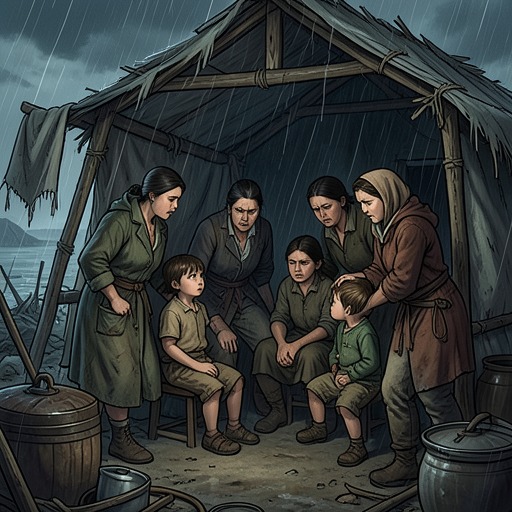
The Wise Ones lead women and children through the wooded grounds toward the old gantry crane and ferry slip. They pass the coal storage house, move between the foundry and chapel, and go by the morgue. These ruins, once components of the hospital complex, now serve as landmarks along a hidden route. Apollo sees the whole community gathered at the landing: nineteen women and eleven children. Their small number makes their exposure there especially evident.
A Pilgrim 40 Pilothouse Trawler appears from the darkness, piloted by a guard from the Wise Ones. The evacuation is conducted in a deliberate order. Older children board first, helped up by guards; infants follow, handed by their mothers to children aged seven and eight, who take them to the protected forward master cabin. The women pass bags and supplies along the line before boarding themselves, assisted by the guards. Within eight minutes the community is ready to leave. North Brother Island has served as shelter and home, but the explosions turn its dock into an exit and its former institutional infrastructure into part of an urgent escape.